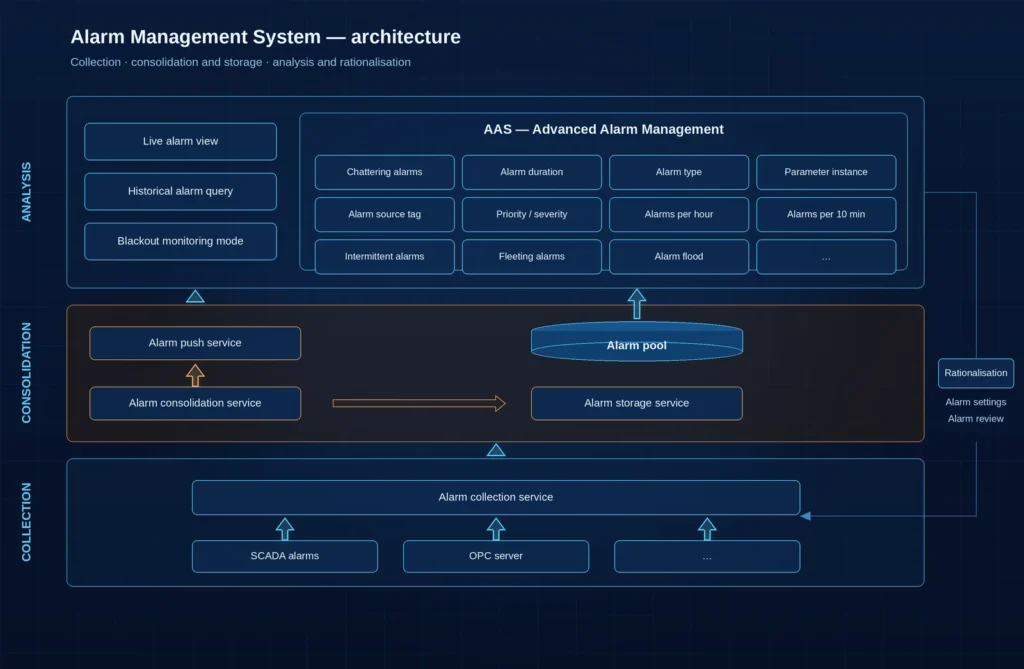
An alarm system that annunciates everything annunciates nothing. Operators stop reading a list they cannot act on, and the alarm that mattered arrives in the middle of two hundred that did not. Fixing that is a data problem before it is a philosophy problem — you cannot rationalise an alarm set you have never measured.
Three layers
| Layer | What happens |
|---|---|
| Collection | Alarms gathered from DCS, SCADA and OPC sources into one store, with a consistent timestamp and source tag |
| Consolidation and storage | Duplicate and mirrored alarms merged; everything retained in an alarm pool that can be queried historically |
| Analysis | Rate, distribution and behaviour analysed so the alarm set can be argued about with evidence |
What the analysis surfaces
| Metric | What it tells you |
|---|---|
| Alarms per hour and per 10 minutes | Whether the operator load is within a workable range at all |
| Alarm flood periods | Where an upset buries the operator, and which alarms make up the flood |
| Chattering alarms | Points cycling in and out of alarm — usually a deadband or instrument problem, not a process one |
| Fleeting alarms | Alarms that clear before anyone could act, adding noise and nothing else |
| Standing alarms | Alarms permanently active, which train operators to ignore the list |
| Repeat offenders | The handful of tags generating a disproportionate share of the total |
In most plants a small number of tags account for a large share of the alarm load. Finding them is the cheapest improvement available, and it needs measurement rather than opinion.
Operator-facing functions
| Function | Use |
|---|---|
| Live alarm view | Current alarm state across the plant |
| Historical query | What was in alarm at a given moment, for incident review |
| Blackout monitoring mode | Reduced-clutter display for periods where only the critical set should be visible |
Scope boundary
| Included | Not included |
|---|---|
| Collection, storage, analysis and the rationalisation workflow | Deciding the alarm philosophy — that is the plant’s call |
| Interfacing to DCS, SCADA and OPC sources | Setting trip and safety limits |
| Configuration and commissioning | Operating the plant |
Talk to an engineer
The first useful step is usually a measurement of the current alarm set. Contact us.
Ask for a technical walkthrough
Tell us the control platform and roughly how many alarms a shift sees today.