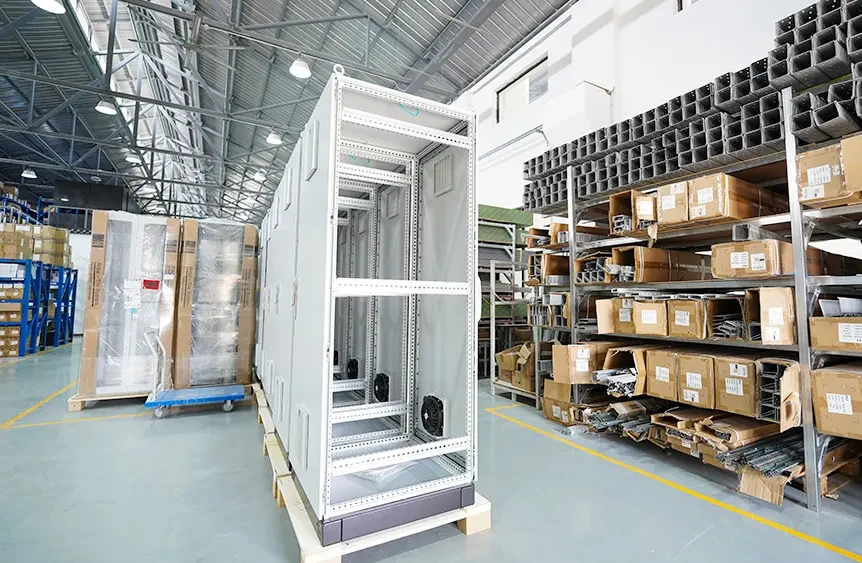
A control cabinet specification is not a shopping list. It is the document that decides who pays when something does not match expectations three months later.
Panel builders quote what is written. If the specification is thin, every bidder fills the gaps with their own house standard, the prices come back looking different for reasons that have nothing to do with quality, and the differences surface at the factory acceptance test when it is expensive to fix them.
What actually drives the price
Worth knowing before you compare quotes, because cabinet cost is mostly a function of terminal count and environment, not of how many boxes there are.
| Driver | Effect |
|---|---|
| I/O point count and type | Sets terminal count, which sets wiring hours — the dominant labour item |
| Redundancy level | Redundant power, controllers and networks can add half again to a system cabinet |
| Hazardous area requirements | Barriers or isolators per intrinsically safe loop, plus segregation |
| Ingress protection and cooling | IP54 with forced ventilation and IP65 with cooling units are different cabinets |
| Mandated component brands | A client-specified brand list removes the builder’s ability to optimise |
| Documentation depth | As-built drawings, test records and O&M packs are real hours |
The clauses people forget
Everyone remembers to specify the enclosure and the I/O. These are the ones that cause arguments:
| Clause | Write it as |
|---|---|
| Spare capacity | A percentage of installed I/O and physical space and terminal spare, separately |
| Labelling convention | One standard for the whole delivery, with an example — not “as per client standard” |
| Wire numbering | Numbered at both ends, matching the loop drawing, ferruled |
| Segregation | Which classes of wiring must be routed separately, and the minimum separation |
| Earthing | Clean earth and dirty earth, with the bonding philosophy stated |
| Test scope | 100% point-to-point, or a sample, and what the record must show |
| Packing | Export packing standard, shipping marks, desiccant, and who lifts it off the truck |
The spare capacity one is worth dwelling on. “20% spare” is ambiguous: spare channels on installed cards, spare card slots, spare terminals, and spare DIN rail are four different things with four different costs. Plants that get this wrong discover it when the first small modification needs a new cabinet.
Specify the test, not just the product
The factory acceptance test is where the specification is enforced, so the specification has to say what the test is. At minimum:
| Test element | What to require |
|---|---|
| Protocol | Issued for review before the test date, not handed out on the morning |
| Coverage | Every I/O point exercised and observed at the graphic, not a sample |
| Failure cases | Redundancy switchover, card removal, network fault, power loss |
| Punch list categories | A / B / C agreed in advance, with A defined as blocking shipment |
| Records | Signed per test case, with the punch list state at close of test |
Agreeing punch list categories in advance is the single highest-leverage line in a cabinet specification. Deciding what counts as a shipment-blocker while standing in the workshop, with a vessel booked, is how factory acceptance tests turn into negotiations.
In-house build versus sub-contracted
Ask any integrator whether they build panels themselves. It is a fair question and the answer changes how the project runs.
| Sub-contracted | In-house |
|---|---|
| Wiring queries route back through the integrator | The engineer walks to the bench |
| The FAT is the first time hardware and software meet | Integration is tested continuously during the build |
| Labelling drifts from the drawings between two companies | One drawing set, one convention, one QC gate |
| Rework needs a shipment | Rework is same-day |
Sub-contracting is not automatically wrong — plenty of good integrators use a regular panel partner. What matters is whether anyone owns the interface between configuration and build, and whether that person is in the room at the test.
A minimum viable specification
If you are short of time, these eight lines will get you comparable bids: I/O schedule with types; cabinet schedule with function and location; redundancy philosophy; hazardous area classification; IP rating and ambient temperature; labelling and wire numbering standard; test scope and punch list categories; documentation deliverables. Everything else can be resolved at design review without changing the price much.
Related: control cabinet manufacturing, engineering, FAT and commissioning.
Send us a cabinet schedule
An I/O list and a preliminary cabinet schedule are enough for a real number rather than a placeholder.