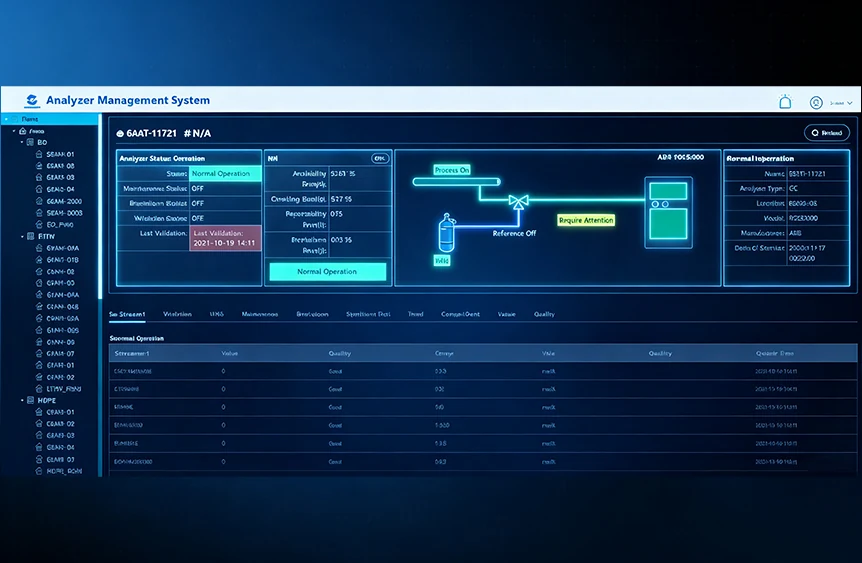
Process analysers get designed into control loops and then quietly designed out of them, because nobody can say whether today’s reading is trustworthy. AMADAS exists to make that answerable: validation against reference samples, health monitoring, and one place where every analyser’s state is visible.
Why analysers lose trust
| Cause | Consequence |
|---|---|
| No routine validation | Drift accumulates unnoticed until a reading is obviously wrong |
| Maintenance is reactive | The analyser is repaired after the loop has already been switched to manual |
| No central view | Each analyser is a local box; nobody sees the fleet |
| No retained record | Quality reporting falls back to lab results, and the on-line measurement becomes decorative |
What the system does
| Function | Effect |
|---|---|
| Validation against reference samples | Readings checked against a known standard, so accuracy is demonstrable rather than assumed |
| Remote automatic validation | The check runs on schedule without sending someone to the shelter |
| Predictive maintenance | Analyser health trended so intervention happens before drift matters |
| Continuous record | Measurements logged and retained for quality reporting |
| Central monitoring | Every field analyser managed from one place |
| Web HMI | Browser-based interface for live data and status |
What it changes
The point is not the dashboard. It is that an analyser with a current, documented validation record can stay in the control loop — which is where it earns its cost. An analyser nobody trusts is an expensive indicator.
Scope boundary
| Included | Not included |
|---|---|
| Analyser management, validation workflow, data acquisition and reporting | Analyser supply, repair and spare parts |
| Integration with the control system and historian | Sample system design and conditioning |
| Configuration and commissioning | Laboratory reference methods |
Talk to an engineer
Tell us how many analysers you run and how they are validated today. Contact us.
Ask for a technical walkthrough
Tell us how many analysers you run and how they are validated today.